
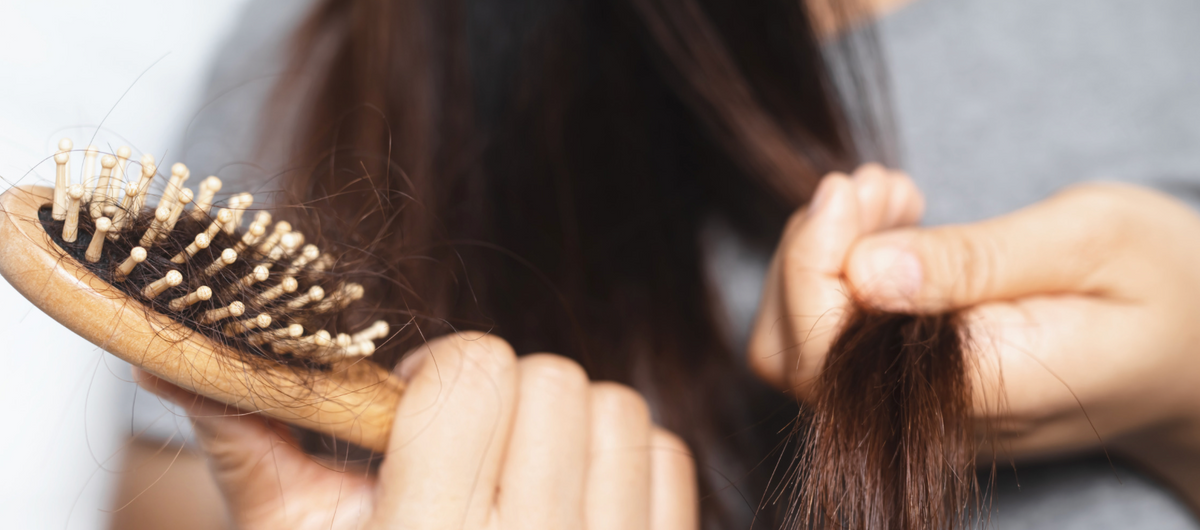
Why Does My Hair Keep Snapping?
You are using a treatment. You bought the expensive brush. You have even started sleeping on a silk pillowcase. So why are there still short pieces of hair around the basin?
Hair breakage is cumulative. It is rarely one spectacularly bad decision. More often, it is bleaching plus heat plus a tight ponytail plus hurried detangling, repeated until the fibre reaches its limit.
Shedding and snapping are different
A naturally shed hair usually comes away as a full-length strand from the root. Breakage tends to appear as shorter pieces, uneven layers, frayed ends, white dots along the fibre or a halo of shorter hairs through areas exposed to the most stress.
New growth can also create short hairs, so length alone is not proof. New growth often has a tapered end and follows the pattern of the hairline or part. Broken hairs may look blunt, split or irregular.
The usual breakage suspects
Bleach and repeated chemical processing
Lightening changes the hair structure so pigment can be removed. Repeated overlap, aggressive processing and insufficient recovery between services can leave the fibre porous and weak. Colour correction is not the moment for optimism. It is the moment for an experienced colourist and a realistic plan.
Heat
High temperatures and repeated passes with straighteners or curling tools remove moisture and increase fibre damage. Use the lowest effective temperature, limit passes and give the hair regular heat-free days.
Hair ties and tight styles
Wearing the same tight ponytail or bun places repeated tension on the same points. Uncovered elastics and ties with metal joins can add friction. Choose covered ties, loosen the style and vary its position.
Persistent pulling can do more than snap the lengths. It may contribute to traction alopecia around the hairline, which can become permanent if the tension continues for long enough.
Rough handling when wet
Wet hair can be more vulnerable to stretching and mechanical damage. Do not scrub it with a towel or attack knots from the root downward. Blot or wrap gently, use appropriate slip and detangle from the ends upward.
Too little conditioning, or the wrong balance
Dry, rough hair experiences more friction. Conditioner helps improve slip and manageability, which can reduce the force needed during detangling.
Protein can help reinforce the feel of weakened hair, but “more protein” is not the answer to every form of damage. Hair that feels hard, rough or inflexible may need moisture and gentler handling rather than another strengthening layer.
The SOPHIC breakage routine
-
Choose the cleanser and conditioner suited to your scalp and hair texture.
-
Use SOPHIC Protein Treatment when the fibre feels weak, overly stretchy or prone to snapping.
-
Alternate or pair it thoughtfully with the SOPHIC Moisture range when hair is also dry or rough.
-
Smooth a small amount of Nourish Oil through the ends to add softness and polish.
-
Reduce the damaging behaviour that created the problem. A treatment cannot outwork daily bleach overlap, extreme heat or constant tension.
You cannot permanently repair a split or severely fractured strand. You can improve how damaged hair feels and behaves, reduce further friction and protect new growth from meeting the same fate.
The glamorous answer is a miracle treatment. The effective answer is a good formula plus consistently less damage.
Shop the routine: Protein Treatment + Moisture Cleanser and Conditioner + Nourish Oil.



Leave a comment
This site is protected by hCaptcha and the hCaptcha Privacy Policy and Terms of Service apply.