
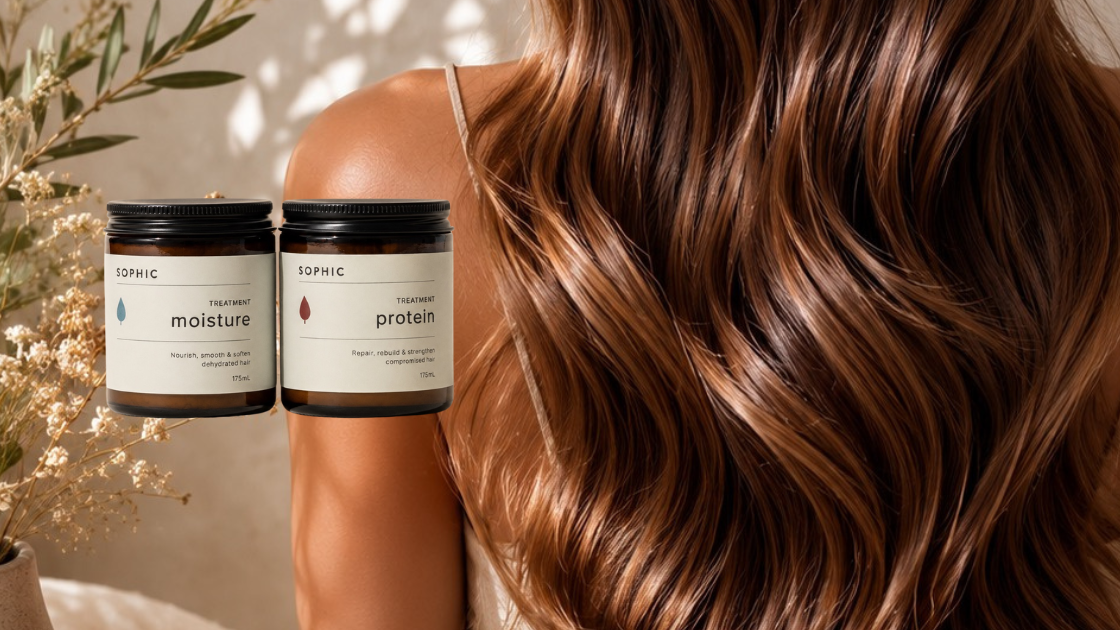
Protein vs Moisture: What Does Your Hair Actually Need?
What does moisture-focused haircare do?
Hair that feels dry often feels rough, dull, stiff, tangled or difficult to manage.
Conditioning and moisture-focused products help improve softness, slip and manageability while reducing friction between fibres.
This can be particularly useful for hair exposed to:
- Regular heat styling
- Colouring or lightening
- Sun and environmental exposure
- Naturally dry or coarse texture
- Frequent washing
- Mechanical friction
Curly hair can also feel dry through the lengths because natural scalp oil does not travel along bends and curves as easily as it does through straighter hair.
When might strengthening care be useful?
Chemical processing, heat and mechanical stress can weaken the hair fibre.
Hair that has become compromised may feel unusually stretchy when wet, snap easily, struggle to retain length or develop increasing numbers of broken pieces.
Strengthening treatments can improve the feel and behaviour of weakened hair and help support damaged areas of the fibre.
They cannot biologically heal a severely damaged strand.
That distinction matters.
If your hair is being repeatedly over-bleached or exposed to extreme heat, no treatment can make those behaviours irrelevant.
Signs your hair may need more moisture
Look at the overall pattern rather than one strand.
Your hair may benefit from greater conditioning and moisture support if it:
- Feels rough or coarse
- Tangles easily
- Looks dull
- Feels dry through the ends
- Has significant frizz associated with dryness or damage
- Feels stiff rather than excessively stretchy
The SOPHIC Moisture range is designed for hair needing softness, conditioning and improved manageability.
Signs strengthening care may belong in your routine
Consider strengthening support when hair:
- Snaps readily during brushing or styling
- Feels weak after chemical processing
- Has lost resilience
- Feels overly stretchy when wet
- Struggles to retain length because the ends continually break
- Shows obvious signs of accumulated damage
SOPHIC Protein Treatment can be introduced when the condition of the fibre suggests strengthening support is useful.
Can hair need both?
Absolutely.
In fact, chemically treated hair frequently does.
Hair can be structurally weakened and dry.
This is why forcing every head of hair into a “protein” or “moisture” category is unnecessarily restrictive.
You might use a moisture-focused cleanser and conditioner regularly, then introduce Protein Treatment periodically according to the condition of the hair.
The routine can change as the hair changes.
More treatment is not always more treatment
This is where people often get themselves into trouble.
If one application helps, using a treatment every day does not necessarily help five times more.
Products should be used according to their directions and your hair’s response.
If your hair begins feeling increasingly stiff, rough, heavy or difficult to manage, reassess what you are using rather than automatically adding another layer.
Start with the behaviour, not the buzzword
Ask yourself:
Is my hair mainly rough and dry?
Start by improving conditioning, reducing friction and supporting softness.
Is it weak and snapping?
Look at strengthening care and, just as importantly, identify the source of the damage.
Is it both?
Build a routine that addresses both rather than choosing sides.
And if your ends are severely split and fractured, there comes a point where scissors are more useful than another treatment.
Haircare can improve the condition, appearance and manageability of damaged hair.
It cannot negotiate with a split end forever.
Shop the moisture routine: SOPHIC Moisture Cleanser + Moisture Conditioner + Moisture Treatment.
Shop strengthening care: SOPHIC Protein Treatment, introduced according to the hair’s condition.

Leave a comment
This site is protected by hCaptcha and the hCaptcha Privacy Policy and Terms of Service apply.