
Microplastics in the Bathroom: Why Haircare Packaging Matters
The beauty industry has spent years making plastic look beautiful.
It arrives frosted, tinted, embossed and dressed in language such as clean, conscious and recyclable. Once the product is finished, however, it is still plastic, and “recyclable” does not guarantee that it will actually be recycled, and in many instances the plastic that it comes in cannot be recycled at all.
Microplastics are tiny plastic particles. Some are intentionally manufactured at a small size for use in products. Many more form as larger plastic items gradually fragment through sunlight, heat, abrasion and time. They do not simply disappear. They become smaller.
The bathroom is part of the problem
Plastic can enter the environment through ingredients in some personal care products, synthetic fibres, disposable items and the breakdown of packaging. Rinse-off products are especially relevant because anything intentionally placed in the formula can travel down the drain during use.
Wastewater treatment can capture some particles, but it does not offer a perfect escape route from the issue. Plastic that is not recovered may reach waterways, while captured material can remain in sewage sludge.
This does not mean one shampoo bottle is solely responsible for a global pollution crisis. It means the repeated choices of a very large industry matter.
Why not simply rely on recycled plastic?
Recycled plastic can reduce demand for virgin material and may be a better option than producing new plastic for every pack. It is still not an endlessly circular material. Plastic quality generally degrades through recycling, collection systems vary, contamination is common and many formats are not economically recovered.
The most useful question is not “Can this theoretically be recycled?” It is “How do we reduce the amount of disposable material required in the first place?”
Why SOPHIC uses glass and aluminium
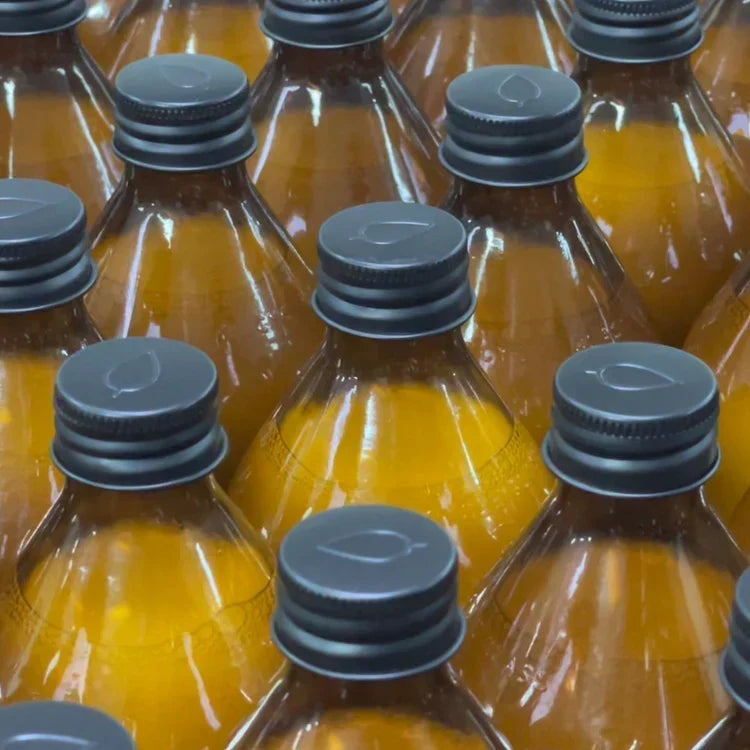
SOPHIC uses amber glass and aluminium across its packaging because we wanted the pack to feel considered before, during and after use.
Glass is durable, highly recyclable and does not break down into microplastic. Aluminium is lightweight relative to many rigid formats and can be recycled repeatedly when it reaches the appropriate system. Neither material is impact-free. Glass takes energy to manufacture and transport, and aluminium production has its own environmental footprint.
That nuance matters. Sustainable packaging is not a purity contest. It is a decision to reduce avoidable waste and design a better system.
Reuse comes before recycling
Our metal pumps are intended to be kept and reused rather than discarded with every bottle. Our larger refill formats help customers buy less packaging for the amount of product they use. The longer a component stays in circulation, the more useful the original material becomes.
For customers, the routine is simple:
-
Keep and reuse your metal pump.
-
Refill or move to a larger format when it suits your household.
-
Rinse and separate components before placing accepted materials in the correct local recycling stream.
-
Check your council’s current rules, as collection systems differ by location.
No single bottle will save the ocean. Equally, millions of “single” bottles are how the problem was created. Better packaging is not the entire answer, but it is a practical place to begin.
Shop the system: SOPHIC 375 ml glass bottles, reusable metal pumps and 1 L refill formats.



Leave a comment
This site is protected by hCaptcha and the hCaptcha Privacy Policy and Terms of Service apply.