
Article: How to Build a Hair Routine Without Buying 10 Products
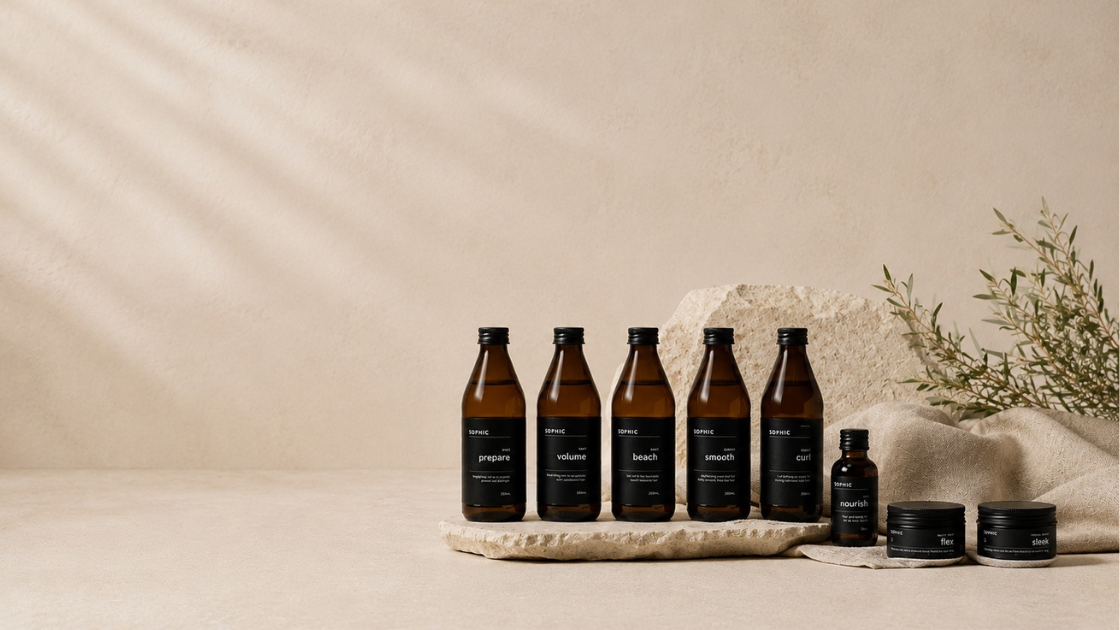
How to Build a Hair Routine Without Buying 10 Products
Step one: understand your scalp
Your scalp and your lengths are connected, but they are not the same thing.
Start by asking:
- How quickly does my scalp become oily?
- Do I exercise or sweat frequently?
- Do I use significant styling product or dry shampoo?
- Does my scalp feel comfortable between washes?
- Is there persistent itching, flaking, pain or inflammation?
Wash according to your scalp rather than following somebody else's schedule.
For a straightforward regular routine, SOPHIC Daily is a sensible starting point.
If oil and build-up accumulate, introduce Revive Cleanser as a scalp reset or use it more regularly when needed.
Persistent scalp symptoms deserve professional assessment rather than another cosmetic experiment.
Step two: look at your lengths
Now ignore the roots for a moment.
What are the lengths doing?
Dry, rough or coarse?
Build around moisture and conditioning.
Weak and snapping?
Consider strengthening support and investigate the source of damage.
Curly?
Use products and techniques that support the natural pattern and reduce unnecessary friction.
Generally healthy and manageable?
Congratulations. You do not need to invent a problem.
Maintain it.
Step three: choose one core wash system
This is where the routine becomes much simpler.
Normal or regular washing
Start with SOPHIC Daily Cleanser + Daily Conditioner.
Dry or rough hair
Choose SOPHIC Moisture Cleanser + Moisture Conditioner.
Curly hair
Use SOPHIC Curly Cleanser + Curly Conditioner, followed by Curl Cream for styling.
Oily or build-up-prone scalp
Introduce SOPHIC Revive Cleanser, then condition the lengths according to their needs.
You do not necessarily need every cleanser SOPHIC makes.
They exist because different hair needs different things.
Step four: add treatment because you need it
A treatment should solve a problem, not fill an empty space on your shower shelf.
Use Moisture Treatment when the hair needs additional conditioning and softness.
Use Protein Treatment when the fibre feels weakened and prone to breakage.
The frequency should reflect the condition of your hair and the product directions.
You do not receive extra credit for treatment night.
Step five: choose styling according to the result you want
Styling is where your desired finish enters the routine.
Want curl definition?
Use Curl Cream.
Want smoother, softer-looking lengths?
Smooth Cream may belong in the routine.
Need texture, volume or hold?
Choose styling according to that goal rather than layering everything together and hoping the products negotiate amongst themselves.
Start with a modest amount.
You can add more.
Removing half a jar of styling product from dry hair is considerably less convenient.
Step six: use oil where oil is useful
Nourish Oil is best treated as a finishing and conditioning product through areas that need softness and polish.
For many people, that means the ends.
Fine hair may require very little.
If your roots become oily quickly, putting a generous amount of oil directly onto them and then becoming annoyed that they look oily is a conflict we can avoid.
Your routine might only need four products
For example:
Dry hair
- Moisture Cleanser
- Moisture Conditioner
- Moisture Treatment when required
- Nourish Oil through the ends
Curly hair
- Curly Cleanser
- Curly Conditioner
- Curl Cream
- Treatment only when the condition of the hair requires it
Fine hair with oily roots and dry ends
- Revive Cleanser
- Appropriate conditioner through the lengths
- Treatment only when needed
- A tiny amount of Nourish Oil through dry ends if useful
Damaged hair
- Cleanser appropriate to the scalp
- Conditioner appropriate to the lengths
- Protein Treatment when strengthening support is required
- Moisture support when the hair is also dry
That is a routine.
It does not require its own bathroom cabinet.
Products cannot compensate for habits
This may be the least profitable haircare advice we could give you:
Sometimes you do not need another product.
You need less heat.
A looser ponytail.
A more careful colour service.
Gentler detangling.
A trim.
More consistent conditioning.
Or simply enough time to see whether the routine you already have is working.
Products are tools.
They work best when the behaviour around them makes sense.
Start simple, then earn every extra step
Choose a cleanser for your scalp.
Choose a conditioner for your lengths.
Add treatment when your hair's condition requires it.
Add styling according to the finish you want.
Then stop.
If another product solves a genuine problem, introduce it.
If you cannot explain what it is supposed to do, your routine probably does not need it yet.
Healthy-looking hair does not require the most complicated routine.
It requires the right one, repeated consistently.


Leave a comment
This site is protected by hCaptcha and the hCaptcha Privacy Policy and Terms of Service apply.